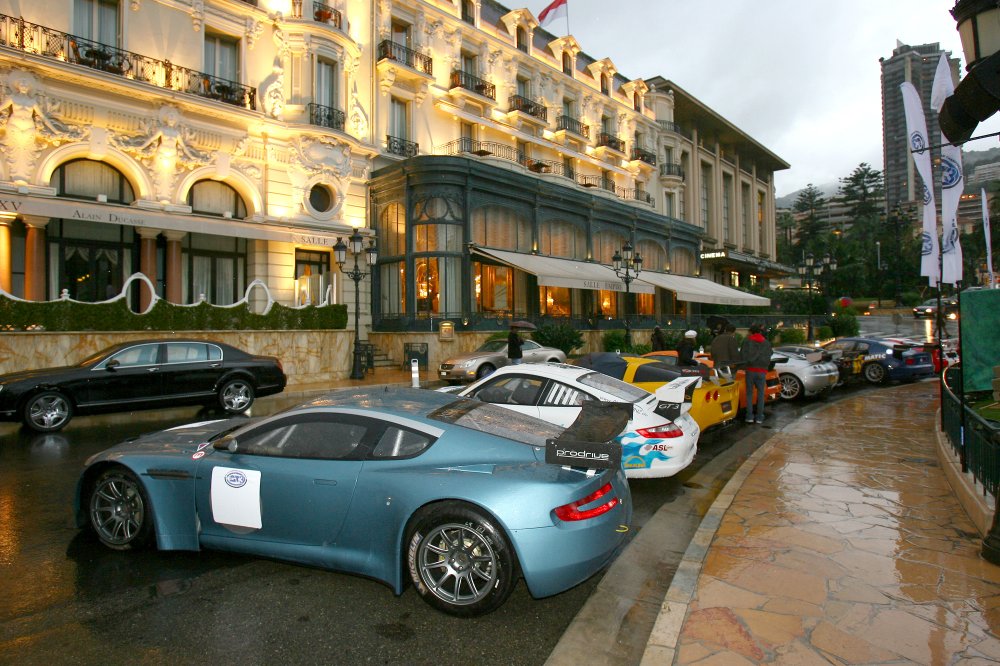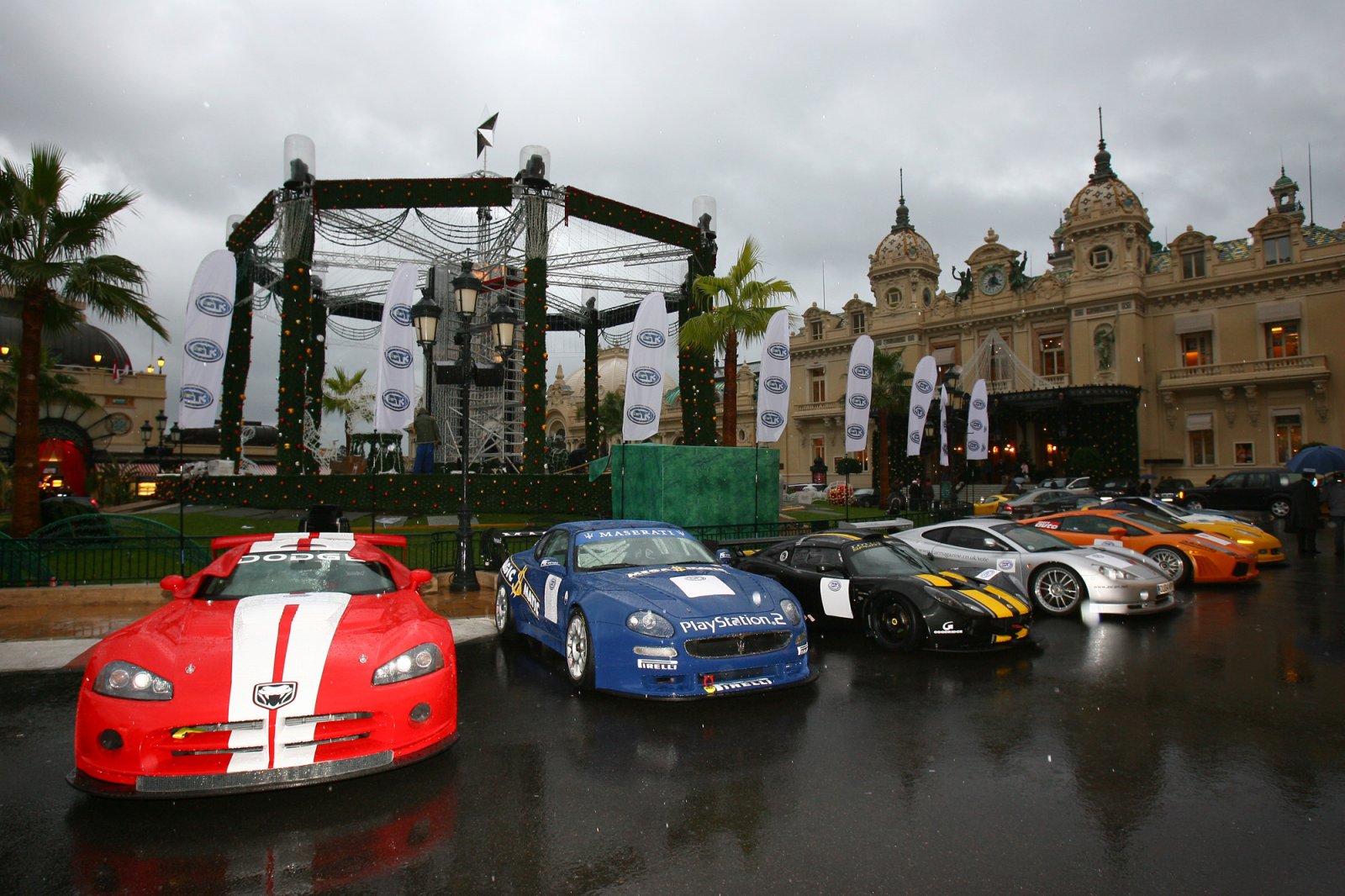
Anyone taking a morning stroll through the rain-soaked streets of Monte-Carlo on 2 December 2005 would have noticed an unexpected addition to the Christmas display on Place du Casino. Nine race cars, each representing a different manufacturer, had been positioned around the base of the festive scene. Featuring a variety of shapes and colours – a blue Maserati, an orange Lamborghini, a silver Ascari – they might have been mistaken for part of the exhibition.
In fact, the cars were present to launch a major new development in world motorsport, one that would have a profound impact on the future of sportscar racing. Later that day, at a press conference in the adjacent Hôtel de Paris, a new category was officially introduced to the world. GT3 had arrived.
The concept held great promise: it had the backing of several manufacturers and full support from FIA President Max Mosley. Nevertheless, even its greatest enthusiasts could not have foreseen the ultimate potential. Indeed, as it heads into its 20th anniversary season, GT3 is firmly established as the world's leading form of sportscar racing.
A LONG-TERM SOLUTION

Like any great innovation, GT3 was a neat answer to a complicated question. While GT racing was booming in the early years of the 21st century, a closer analysis suggested that its success could ultimately be its downfall. Increased competition had sent budgets skywards as manufacturers fought for supremacy, while the amateur drivers who had facilitated its renaissance were being forced out by an influx of professionals. There was also a growing sense that a small number of marques would attain a stranglehold, prompting the rest to walk away.
First presented to the FIA by Stéphane Ratel, then the FIA GT Championship promoter, in November 2004, the objective of the new GT3 category was to create a more cost-effective formula in which a wide variety of desirable models could compete on a level playing field. The participation of amateur drivers would be strongly encouraged, with top-line professionals effectively banned.
The new breed of cars would compete in a standalone series – the FIA GT3 European Championship – with running costs expected to be around one third of those for a GT2 car. Crucially, it would rely on existing models, saving manufacturers the significant cost of building an entirely new car to satisfy a set of regulations. As Ratel explained at the time: “You put a lot of engineers on the job, a lot of money, and you arrive with cars that are all similar to each other.
“When you start from a GT car – and we want to start from road-cars – you start from very different architectures,” he continued. “You have cars with front engines, mid engines, rear engines. You have six cylinders, eight cylinders, ten or twelve cylinders.
“The architect of this was Peter Wright, and the idea really came from President Mosley, which was that if you start from production cars, there will be a way to balance these cars and give them the same performance,” Ratel added.
There can be no question that Wright, who had been FIA technical advisor since 1995, played a pivotal role in the GT3 story. In late 2004, the Englishman was tasked with balancing the Maserati MC12 – a thoroughbred race car built using F1 technology from Ferrari – to compete in the FIA GT Championship. What we now call Balance of Performance had never previously been attempted at such a high level, but Wright pulled it off.
GT3 would embrace the concept fully, allowing marques that had previously been excluded from international competition to join the grid. The 2006 field would ultimately feature eight models: the Ascari KZ1R, Aston Martin DBRS9, Corvette Z06, Dodge Viper Coupe, Lamborghini Gallardo, Ferrari F430, Maserati Gran Sport Light, and Porsche 997. Venturi and Lotus were also present at the official launch but did not participate in the inaugural FIA GT3 European Championship.
“We will put all these cars on the track, starting tomorrow in Paul Ricard, followed by another test in March and a final test in April,” Ratel explained during the press conference. “We will compare their performances and, with the same system used in GT1, with the expertise of Peter Wright and all the technical departments of the FIA, we will put these cars under the same performance. We are very confident, after what we proved in GT1, that we will succeed in GT3.”
Testing was carried out by two-time 24 Hours of Spa winner Christophe Bouchut, whose vast experience made him the ideal candidate to benchmark each car’s performance. On 3 December the Frenchman completed more than 400 kilometres of running, sampling eight different models across four-and-a-half hours. While that is not beyond the physical capabilities of a race-fit professional, jumping between such different machines must have posed a considerable mental challenge.
“It was a very busy day,” Bouchut confirmed afterwards. “It was exhausting, but very satisfying, and I am very pleased that I did not make any mistakes. The cars are so very different, it is quite amazing that globally their performances are really so similar.”

FROM CONCEPT TO COMPETITION
Five months after its official launch, the FIA GT3 European Championship hit the track for the first time with a 44-car entry arriving at Silverstone. Two of the teams that competed that weekend remained active in GT World Challenge Europe powered by AWS in 2025: AF Corse and Barwell Motorsport. Back then the latter was an unknown in GT racing, having established its name in touring cars. But, when Aston Martin called to ask if they would run the DBRS9, team boss Mark Lemmer jumped at the chance.
“Little did we know then that having three DBRS9s on that very first GT3 grid at Silverstone would be the start of an incredible 20-year journey with both GT3 and SRO,” Lemmer reflects today. "It is only us and AF Corse that have been present continuously within the SRO GT3 world since, and it’s been a privilege to be part of it.
“While the formula has changed a lot technologically across the years – cars are now faster, more complex and more demanding – the spirit of competition and the thrill of the racing remains as bright as it has ever been. That can only signal great things for the future of GT3, as interest and audiences continue to grow.”
The numbers back this up. Taking the example of GT World Challenge Europe, the 2025 season saw record grids in both the Sprint Cup and the Endurance Cup, the latter including a monster 75-car entry for the flagship CrowdStrike 24 Hours of Spa. GT3 is also booming in a host of other SRO series around the globe, as well as the FIA World Endurance Championship, IMSA, Super GT, the DTM, and many others.
While it is now awash with professional drivers – don’t forget that Max Verstappen has raced a GT3 car this year – the formula also remains popular with the semi-pro and amateur competitors who were so important to its creation. Indeed, it is this variety that keeps GT3 thriving two decades after its launch. From the best driver on the planet to those who race as a hobby, it manages to offer something for everyone.
To mark the 20th anniversary, SRO has joined forces with classic motorsport specialist Peter Auto to launch the GT3 Revival Series. Beginning in 2026, this will feature cars from the first eight years of the category, with an emphasis on amateur competitors ensuring an even closer connection with the founding principles of GT3. The anniversary will also be at the centre of next year’s CrowdStrike 24 Hours of Spa, which will include a GT3 Legends race. It is a testament to the category’s longevity that contemporary and historic series exist side by side.
The anniversary is especially poignant given that Wright passed away at the beginning of November 2025. In his obituary, Stéphane Ratel called the Englishman “the father of BoP” and underlined his impact on global motor racing. “Without it there would be no GT3, GT4, Hypercars or TCR. The sport owes him a debt of gratitude.”
From national series to the biggest GT race in the world, there is no shortage of opportunities to see the fruits of the work that Wright was part of 20 years ago. Indeed, GT3 and the concepts that underpin it feel more relevant today than ever before. That is a remarkable legacy and one that looks set to continue for years to come.